OBSAH

How can I become aware of and exercise my pelvic floor?

Picture of tobe_admin

tobe_admin

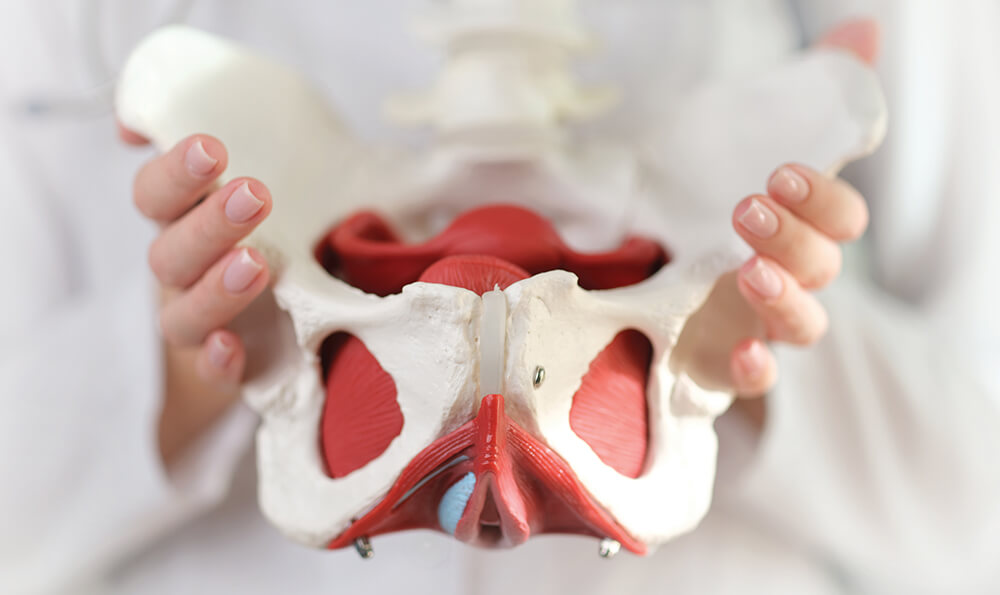
To find and feel your pelvic floor, it’s a good idea to review your anatomy at least a little. The pelvic floor is made up of soft tissues that line the pelvic cavity—our “floor.” The muscle fibers of the floor form and converge into the external sphincters. Beneath this imaginary surface layer are fibers that connect the space between the ischial tuberosities. The ischial tuberosities are those “buddies” that press against us and cause pain when we ride a bike. Beneath this layer lies another, the deepest one, in which muscle fibers connect the pubic bone to the coccyx region.

Anatomically, it is a relatively complex system that is, in essence, perfect and fully adapted to the work it constantly performs. The pelvic floor performs many functions and is involved in numerous processes. If it’s working properly, we shouldn’t even be aware of it. It’s similar to breathing—when everything is working as it should, we don’t think about breathing. We don’t think about the pelvic floor either; we aren’t particularly aware of it during the day. When we need to go to the bathroom to have a bowel movement during the day, it simply happens.

However, as soon as a problem arises in the pelvic area, that area becomes the focus of our attention. Suddenly, we become more aware of this area; we pay closer attention to it, checking to see if anything down there hurts, feels tight, or causes irritation. Common symptoms of pelvic floor dysfunction include abdominal bloating, painful menstruation, or pain during intercourse; problems with urination and bowel movements may also occur.

You can easily examine and feel your pelvic floor on your own. Simply insert one finger vaginally and try to contract your pelvic floor muscles. In other words, try to squeeze the finger inside your vagina with your muscles, pull it inward, and then relax. This will give you at least a basic idea of whether you’re able to consciously contract and then relax these muscles. Both of these actions—contracting and relaxing—are very important.

You can exercise your pelvic floor during everyday activities; all you need to do is become aware of your pelvic floor, visualize that area, and try to perform a few conscious contractions. As you exhale, pull your pelvic floor—all three layers—inward, and then relax as you inhale. You can also train your pelvic floor for endurance by contracting all the muscles, holding the contraction for a few seconds, and then releasing. This way, you strengthen and tone your pelvic floor and bring it under conscious control. It’s a good idea to work on your pelvic floor in various positions—not just while lying down, but also while sitting, standing, and even standing on one leg.

There is a MYTH circulating among people that we also exercise our pelvic floor muscles when we interrupt urination—that is, when we stop the flow of urine. This is a very unhealthy practice and can lead to serious problems. Trying this once is fine to see if you can do it, but doing this regularly can cause real problems because it disrupts the micturition reflex. When you feel the urge to urinate, your brain signals that you need to empty your bladder, and at that moment, you need to completely relax, relax your pelvic floor, dilate the urethra, and fully empty your bladder. If you regularly disrupt this reflex, you may develop urgency syndrome.

CITLIVÝ PRÍSTUP

Potrebujete viac?

Ak potrebujete vedieť viac, objednajte sa 

SÚVISIACE TÉMY

→ Šestonedelie
→ Panvové dno
→ GravidityFyzio
→ KidsFyzio

The body does not need to be fixed. It needs to be understood.

I am a woman, wife, mother and physiotherapist. Over the years of practice, I have realised that health does not come only from eliminating symptoms or solving a specific problem. Real change comes when a person begins to better understand themselves, their body, and the way they live their life.

It was this idea that led me to create the space you know today as ToBe – a place where different areas of expertise, perspectives, and approaches to health are interconnected. A place that does not see a person only through a diagnosis or individual symptoms, but as a unique whole.

My professional journey began in physiotherapy and the musculoskeletal system. Over time, clients and their stories gradually led me deeper – from working with the body through the pelvic floor to understanding the meaning of emotions, the psyche, and the functioning of the nervous system. Today, I see the body as the bearer of a person’s story, and therapy as a space where we can get to know that story, understand it, and support its natural process of change.

How I work

Years of practice have taught me to slow down. To listen more. To place less emphasis on performance, results, or quick change.

In therapy, I strive to create a safe space where clients can become more aware of their bodies, their needs, and the connections between what they are experiencing and what is happening on a physical level. I don’t focus only on symptoms; I also look for their possible causes and the context in which they arise.

Over the years, I have become increasingly aware of how closely the body, mind, and nervous system are connected. This is why I naturally integrate a psychosomatic perspective and the principles of nervous system regulation into my work – gently, clearly, and always with respect for where each client is in their own process.

I believe the body has a remarkable capacity for healing and renewal. Sometimes it doesn’t need more pressure — it needs understanding, a sense of safety, and the right conditions to begin functioning in a different way.

What I can help you with

In my practice, I specialise mainly in:

  • urogynecological physiotherapy
  • pelvic floor dysfunction
  • incontinence
  • painful conditions after childbirth
  • preparation for childbirth and postpartum recovery
  • painful menstruation
  • pain during sexual intercourse
  • functional disorders of the musculoskeletal system
  • chronic pain without an organic cause
  • unintegrated scars
  • psychosomatic connections of health problems
  • regulation of the nervous system

Methods and approaches I use

In my work, I connect physiotherapy with knowledge from psychosomatics, work with the nervous system, and a holistic therapeutic approach. I mainly use:

  • urogynecological physiotherapy
  • pelvic floor therapy
  • diagnosis and therapy of functional disorders of the musculoskeletal system
  • visceral manipulation
  • osteopathic principles
  • craniosacral therapy
  • psychosomatic approach in physiotherapy
  • principles of nervous system regulation
  • knowledge from Somatic Experiencing® training

In therapy, I combine professional knowledge with a sensitive perception of the person and their story. My goal is not only to relieve the problem, but to support the client in better understanding themselves and their body.

ToBe – the concept

ToBe grew naturally out of the original IntimFyzio centre. Over time, I increasingly felt the need to bring different areas of expertise together and create a place where a person does not have to be divided into separate parts.

Today, ToBe is a multidisciplinary space where physiotherapy, psychology, psychotherapy, women’s health, traditional Chinese medicine, work with the nervous system, and other approaches come together – united by a common idea: to see a person in their entirety and create the conditions for health, growth, and a deeper connection with oneself.

Education and professional development

I studied physiotherapy at the Faculty of Medicine of Comenius University in Bratislava, and completed my master’s degree at the University of Brighton in the United Kingdom.

I have completed a specialisation in functional and structural disorders of the musculoskeletal system at the Slovak Medical University in Bratislava. I hold a licence for independent medical practice and am a member of the Slovak Chamber of Physiotherapists.

Training that has significantly shaped my therapeutic approach

  • Somatic Experiencing® (currently in training, Lilian Troost)
  • Psychosomatic approach in physiotherapy (CKP Edu, Prague)
  • Visceral manipulation and osteopathic approach (Inge Schuermans, MSc)
  • Birth trauma in physiotherapy and self-regulation tools in client practice (Mgr. Radka Tomášková)
  • Holistic approach to scar and pelvic floor therapy (PhDr. Michaela Prokešová, PhD.)
  • Traditional care for women and mothers (Angelina Miranda Martinez)
  • Osteopathic approach in pregnancy and gynaecological dysfunctions (Inge Schuermans, Jory Paul)
  • Ludmila Mojžišová method (Mgr. Jana Jedličková)
  • Physiotherapy of pelvic floor dysfunction and urinary incontinence (Prof. Magdaléna Hágovská, Mgr. Zuzana Woleková)
  • Craniosacral therapy (Mgr. Helena Toušková, Upledger Institute)
  • Certified DNS Therapist Diploma (Prof. Pavel Kolář)
  • Diagnosis and Therapy of Functional Disorders of the Musculoskeletal System (Eva Janíková)
  • Stott Pilates (Jitka Kadish)

I believe health is not a goal to be achieved. It is a relationship we build with ourselves, our bodies, and our lives – and it is a journey I love to accompany my clients on.